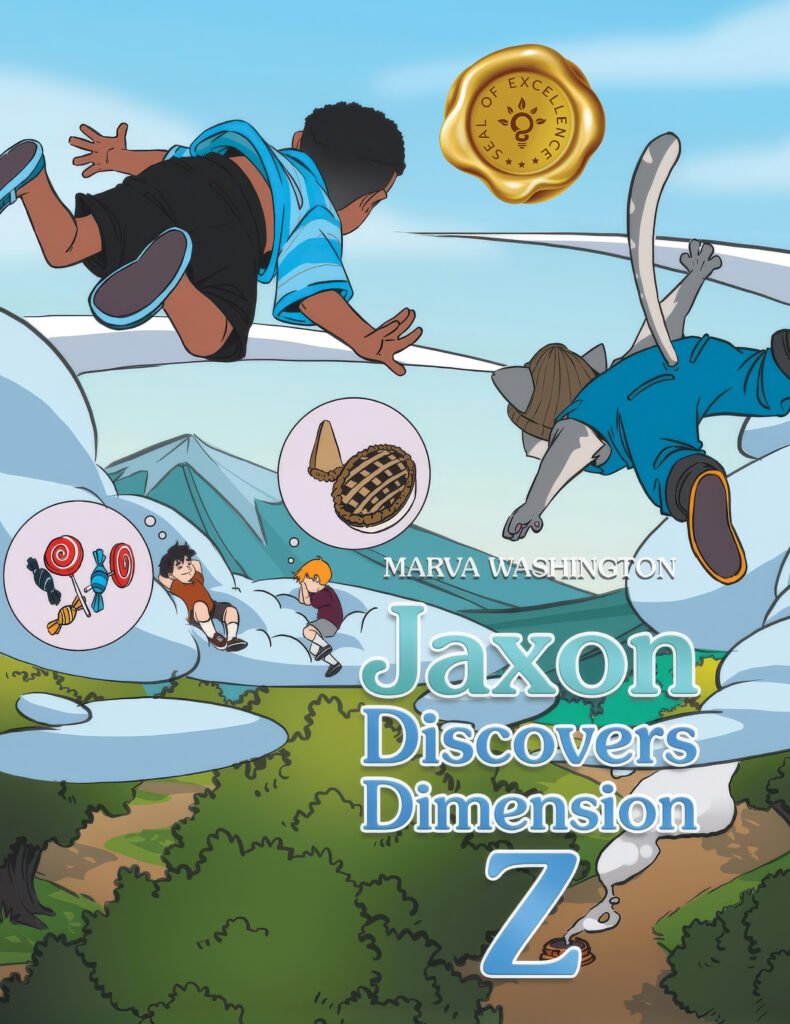
Jaxon Discovers Dimension Z
Children’s adventure • Imagination • Friendship • Courage
Jaxon’s week-long trip to visit Grandmom in South Carolina starts with a plan: expand his taste beyond white rice and chicken and fries. With a vegetable garden and freshly grown plants, Grandmom introduces him to new foods and encourages him to try something different.
But the real adventure begins behind the garden—inside a tool shed Grandmom warned him to avoid. Curious as ever, Jaxon enters…and finds an otherworldly creature on a personal mission. The visitor isn’t from Jaxon’s dimension and carries secrets he won’t share. When Jaxon uncovers the truth, he agrees to help—yet he can’t tell anyone, not even Grandmom.
Left to solve problems far beyond his experience, Jaxon must rely on courage, kindness, and quick thinking—discovering that courtesy and compassion can be powerful tools on any journey.
What Readers Can Expect
A fun adventure with heart
- A secret discovery: A forbidden shed, a surprising visitor, and a mission from another dimension.
- Adventure and imagination: A story that encourages kids to think bigger and explore new possibilities.
- Friendship and kindness: A heartwarming bond that shows how compassion can lead to success.
- Problem-solving: Jaxon faces challenges that require bravery, patience, and creative thinking.
- Positive values: Courtesy, empathy, and resilience woven naturally into the journey.
What Readers Can Expect
What the story reinforces
- Curiosity and discovery
- Friendship and trust
- Kindness as strength
- Courage in unfamiliar situations
- Learning and growth (inside and out)
Ideal For
Readers who enjoy
- Imaginative children’s adventures
- Stories with gentle life lessons
- Friendship-centered storytelling
- Books that spark curiosity
- Positive themes (kindness, courage)
- Reads adults can enjoy too
Reviewed by The US Review of Books
Editorial review highlight
“Washington’s book does one thing exceptionally well: it surprises the reader. When Zolo describes Dimension Z as an idyllic world of candy and lollipops, we fear, for a moment, that his portrayal might be accurate. But then, the tables are turned; Dimension Z is revealed to be a dystopian world in which children’s carnal desires are used to enslave them… Washington has crafted a memorable addition to children’s literature.”
Read Full Review
Jaxon Discovers Dimension Z
by Marva Washington
iUniverse
book review by Boze Herrington
“As he awaken slowly, he became reenergized to the point where he could become engaged in logical conversation.”
While visiting his grandmother in South Carolina, Jaxon is troubled by strange and only half-remembered dreams. “Grandmom” is keen to encourage a delight in healthy foods by helping him grow his own vegetable garden. But as Jaxon explores the shed, he encounters a mysterious, catlike creature with a shifty air who telepathically tells him he hails from another dimension—Dimension Z.
The creature explains that his name is Zolo and that he’s speaking to Jaxon in the form of a hologram. Zolo describes his home dimension as “a place of endless possibilities, full of innocence, and lollipops and ice cream.” Jaxon feels an instinctive dislike for the haughty airs displayed by the strange critter, who admits that he was obliged to steal food from the garden, but found that he couldn’t eat earth food unless someone gave him the food. Zolo needs Jaxon’s aid to return home, from whence he has been banished, but is disappointed to learn that the boy can’t be manipulated easily.
Falling asleep at the dining room table, Jaxon is transported by Zolo into Dimension Z. He is troubled by much of what he sees there. In the Outerlands, thousands of children are enjoying mountains of unwholesome candies and fatty foods. Like with the enchanted Turkish delight in Narnia, once the children taste the sweets, they find it impossible to stop eating. Zolo explains that Zedgatarians like himself are “vegetarians by nature,” but that the decadent treats of the Outerlands present a persistent allure. As they proceed on their journey, Jaxon ponders the dangers of addictive sweets and the joys of natural, healthy foods.
Washington’s book does one thing exceptionally well: it surprises the reader. When Zolo describes Dimension Z as an idyllic world of candy and lollipops, we fear, for a moment, that his portrayal might be accurate. But then, the tables are turned; Dimension Z is revealed to be a dystopian world in which children’s carnal desires are used to enslave them. This places Zolo’s world in a long literary tradition that includes the island of the Lotus-Eaters in Greek mythology, the Land of Toys in Pinocchio, and modern children’s classics such as Coraline, The Thief of Always, and Something Wicked This Way Comes. The reveal that Zolo is unreliable greatly strengthens the narrative, steering it away from the safe and predictable towards something altogether more sinister and original.
Including moral lessons in a children’s story can be a perilous venture, as it risks being heavy-handed. However, Washington handles the didactic aspects with finesse. The book is reminiscent at times of both The Phantom Tollbooth and Pilgrim’s Progress, two classic fantasies in which a character stumbles into misadventures through his own folly, to the reader’s edification. There’s enough imagination on display to sweeten the lessons about “food deserts” and the benefits of a balanced diet. The book offers just enough information about the Zedgatarians, the Yum-Yums, the Friers, and the Wicket Stickers to leave the reader wanting to know more. Washington has crafted a memorable addition to children’s literature.
Reviews
Reviews sourced from Amazon
Book: Jaxon Discovers Dimension Z
Donna
Reviewed on Amazon
“This book has appeal to both adults and children. The vivid illustrations brought the story to life.”
Questions or Reader Correspondence?
For general inquiries, publishing-related questions, media requests, or reader correspondence, please use the Contact page. All communication is handled through official channels.